





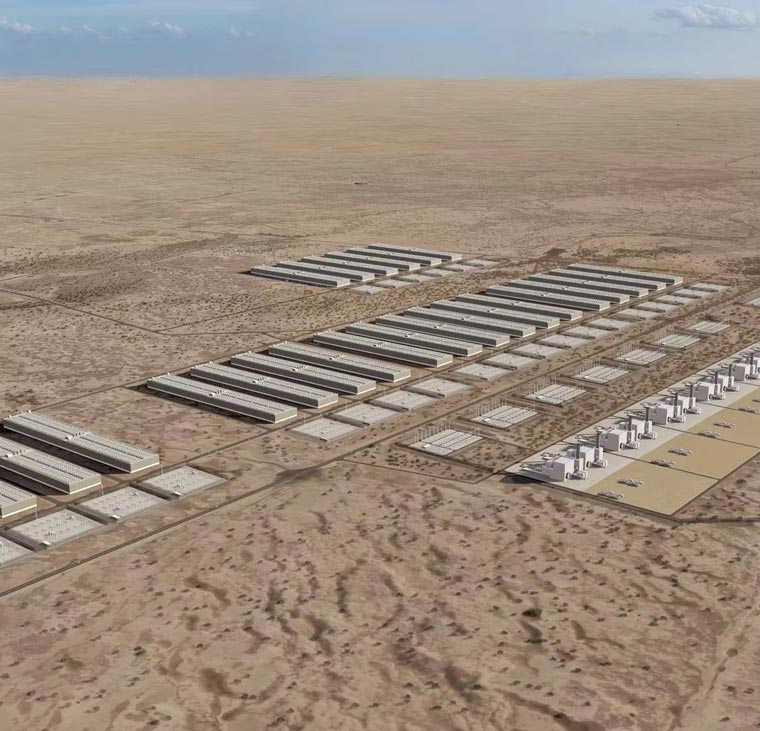
DALLAS—(BUSINESS WIRE)—Pacifico Energy recently announced a major advancement of its GW Ranch project, a private-grid power generation campus in West Texas purpose-built for hyperscale data centers and the next wave of AI innovation. GW Ranch has received its Texas Commission on Environmental Quality (TCEQ) air permit for 7.65 GW of gas-fired power generation, the largest permit granted in the United States of America. Securing the TCEQ air permit authorizes construction and operation under state and federal air-quality requirements. This approval validates Pacifico’s emissions-control strategy and advances a key regulatory milestone on the path to commercial operation.
With major permitting now complete, GW Ranch is a partner-ready energy platform, built to support multi-phase, hyperscale demand with regulatory certainty and operational flexibility. This marks a major regulatory milestone for one of the nation’s most significant energy projects.
“We’re really excited to reach this precedent-setting milestone at GW Ranch,” said Nate Franklin, CEO of Pacifico Energy Group. “As Texas solidifies its role as a leading market for data center expansion, this 7.65 GW TCEQ air permit underscores our ability to deliver the scale, speed, and regulatory certainty that hyperscale and other large-load customers require.”
As electricity prices rise nationwide and large data center loads place growing pressure on regional grids, Pacifico’s development philosophy is intentionally designed to protect ratepayers. Utilizing a private-grid that combines natural gas turbines, solar, and battery storage, GW Ranch enables rapid AI and digital infrastructure growth without impacting the electricity grid or increasing energy costs for Texans.
“Receiving TCEQ approval for the largest power project in the United States is a defining milestone for GW Ranch, and clears a critical path for delivering power at a scale the market urgently needs,” said Constantyn Gieskes, Vice President of Project Development at Pacifico Energy. “With all site delineations complete, permits in-hand, and turbines secured, GW Ranch will provide customers with power in the first half of 2027 with a guaranteed pathway to scale to over 5 GW.”
GW Ranch is now the largest fully permitted power-for-AI data center campus in the U.S. With strong local support and a focus on sustainable development, GW Ranch will drive economic growth, support local industries, and help the U.S. maintain its position as a world leader in AI innovation.
Project Highlights:
- Total Gross Capacity: 7.65 GW (Gas) + 1.8 GW (Battery Energy Storage) + 750 MWac (Solar)
- Location: Pecos County, Texas
- Availability: >99.99%
- Acreage: 8,000+ build-ready with space for future expansion
- Gas Supply: Multiple laterals, including a 15-mile 1 BCF/d direct pipeline to Waha for unmatched gas supply optionality
- Phase 1 Gross Capacity: 1 GW
- Phase 1 First Power: H1-2027
According to The Texas Tribune, this permit—while accommodating gas production for the GW Ranch campus—is also the largest air pollution permit in the country.
Texas’ environmental regulator this week issued the largest air pollution permit in the country to an enormous planned complex of gas power plants and data centers near the oilfields of the Permian Basin, according to an announcement from the project’s developers.
It’s among a handful of similarly colossal ventures announced during 2025 that have made Texas the global epicenter of a gas power buildout, according to data released [Thursday] by Global Energy Monitor (GEM).
The article went further to explain the environmental drawbacks of the permitting:
The planned hyperscale facilities of north and west Texas, if fully built out, could be among the largest emissions sources in both the country and the world, said Griffin Bird, [a research analyst who tracks gas plants for the nonprofit Environmental Integrity Project in Washington, D.C.]
Pacifico’s GW Ranch in Pecos County is authorized to release more than 12,000 tons per year of regulated air pollutants, according to permitting documents from the Texas Commission on Environmental Quality, including soot, ammonia, carbon monoxide, and volatile organic compounds.
The complex can also release up to 33 million tons per year of greenhouse gases, according to permitting documents, equal to nearly 5% of the total annual greenhouse gas emissions of Canada.
Texas currently has 11 gas power plant projects under construction, according to Global Energy Monitor (GEM) data. It has 102 projects under preconstruction — acquiring land, permits, and contracts. Another 28 projects have been announced.
Tagged with data centers, grid