





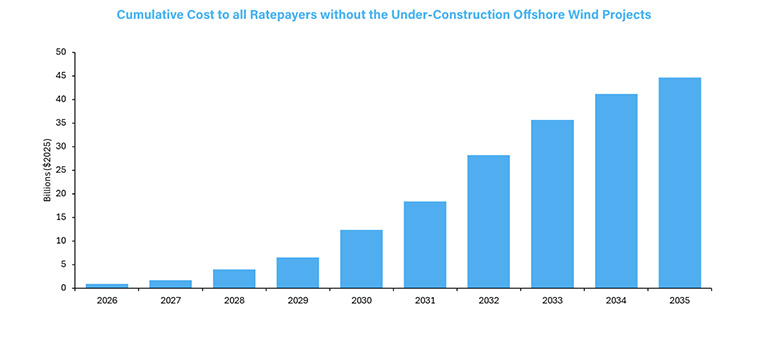
Washington, D.C. — Cancelling five major offshore wind projects could raise electricity costs for customers on the East Coast by an estimated $45 billion over the next decade, according to a new analysis from the American Clean Power Association (ACP). As demand soars across the nation, the five projects together would provide nearly 6GW of power for the region and power over 2.5 million homes.
On December 22, the U.S. Department of the Interior issued a stop-work order for five offshore wind projects. These projects that serve regions within the PJM, NYISO, and ISO-New England power markets are already under construction — most are over 70% completed — and have undergone years of review by National Oceanic and Atmospheric Administration, the Department of the Interior, the Department of War, and other federal offices.
“It’s a simple supply and demand equation at this point. The demand for energy is increasing, and we need all forms of energy to meet this demand — including offshore wind — or customers will end up paying for it,” said John Hensley, Senior Vice President of Markets and Policy Analysis at ACP. “These projects lower electricity costs. Delaying or cancelling them puts reliability at risk and forces families and businesses to pay more—plain and simple.”
In its analysis, ACP evaluated the impact of removing the five offshore wind projects from the system. The results were then translated into expected retail electricity rates across 15 states and Washington, D.C.
The findings show that without these offshore wind resources:
- Wholesale electricity prices would rise significantly during evening peaks and winter hours – including intense winter storms like Fern
- Power systems would rely more heavily on non-renewable sources and leave customers more exposed to price volatility
- Grids would lose access to low-cost, winter-peaking clean energy that helps stabilize prices during periods of high demand
At peak times, electricity prices are set by the most expensive power plant needed to meet demand. Offshore wind reduces reliance on those high-cost plants, replacing them with steady, lower-cost power that helps stabilize prices.
“The suspension of these projects will raise electricity bills for families and businesses along the East Coast,” Hensley added. “The cost of inaction could be felt in monthly utility bills for years to come.”
ACP urges policymakers to consider the significant consumer cost impacts of delaying offshore wind development and to work toward solutions that protect national security while ensuring affordable, reliable electricity for the region.
Tagged with ACP, offshore wind