

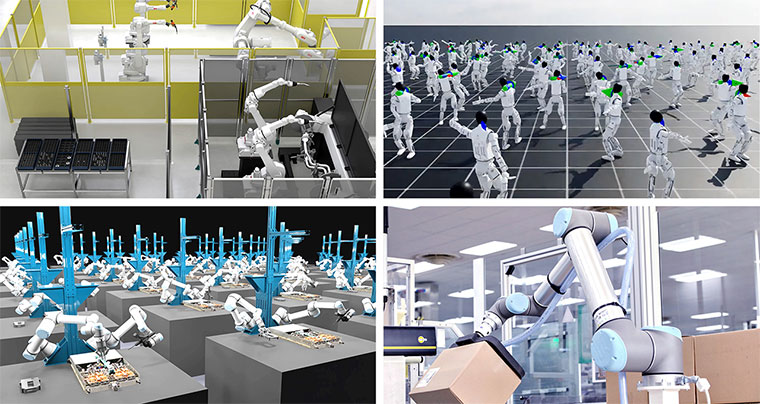




SAN JOSE, Calif. — NVIDIA is partnering with the global robotics ecosystem — including leading robot brain developers, industrial robot giants and humanoid pioneers — to power production-scale physical AI. NVIDIA also unveiled new NVIDIA Isaac™ simulation frameworks and new NVIDIA Cosmos™ and NVIDIA Isaac GR00T open models for the industry to develop, train and deploy the next generation of intelligent robots.
Industry leaders building on the NVIDIA platform include ABB Robotics, AGIBOT, Agility, FANUC, Figure, Hexagon Robotics, KUKA, Skild AI, Universal Robots, World Labs and YASKAWA.
“Physical AI has arrived — every industrial company will become a robotics company,” said Jensen Huang, founder and CEO of NVIDIA. “NVIDIA’s full-stack platform — spanning computing, open models and software frameworks — is the foundation for the robotics industry, uniting a worldwide ecosystem to build the intelligent machines that will power the next generation of factories, logistics, transportation and infrastructure.”
Validating the World’s Largest Robotic Fleets
As industrial robotics becomes more AI driven, manufacturers need physically accurate, high-fidelity simulation to design, test and optimize systems before deployment.
With a global install base exceeding 2 million robots, FANUC, ABB Robotics, YASKAWA and KUKA are integrating NVIDIA Omniverse™ libraries and NVIDIA Isaac simulation frameworks into their virtual commissioning solutions to develop and validate complex robot applications and entire production lines through physically accurate digital twins. To power advanced intelligence on the production line, the companies are integrating NVIDIA Jetson™ modules into their controllers for real-time AI inference at the edge.
Building Robot Brains for Any Embodiment
Robotics is evolving from task-specific machines to adaptable generalist-specialist systems that maintain the precision and reliability required for industrial-grade deployment. To achieve this, robots need humanlike reasoning and the ability to perceive, decide and act autonomously.
Leading developers such as FieldAI and Skild AI are building generalized robot brains using NVIDIA Cosmos world models for data generation and Isaac simulation frameworks to validate policies in simulation, enabling any robot to master new tasks with minimal retraining. World Labs is using Isaac Sim™ to validate its generative world models, while Generalist AI is using Cosmos to explore generating synthetic data.
NVIDIA today announced Cosmos 3, the first world foundation model unifying synthetic world generation, vision reasoning and action simulation to accelerate the development of generalized robot intelligence for complex environments.
Powering the Next Generation of Humanoid Robots
Building humanoid robots is one of robotics’ greatest challenges. Replicating human mobility, dexterity and reasoning requires tightly integrating advanced AI, perception and real-time control into a safe, reliable and autonomous system.
Leaders including 1X, AGIBOT, Agility, Agile Robots, Boston Dynamics, Figure, Hexagon Robotics, Humanoid, Mentee and NEURA Robotics are building the next generation of humanoids using Cosmos world models, Isaac Sim and Isaac Lab to accelerate the development and validation of their robots.
NVIDIA today introduced Isaac Lab 3.0 in early access, enabling faster, large-scale robot learning on NVIDIA DGX™-class infrastructure. Built on the new Newton physics engine 1.0 and the NVIDIA PhysX® software development kit, it adds multiphysics simulation and improved support for complex, dexterous manipulation.
AGIBOT, Humanoid, LG Electronics, NEURA Robotics and Noble Machines are also adopting NVIDIA Isaac GR00T N models to accelerate industrial deployments of their humanoids. NVIDIA announced GR00T N1.7 is now available in early access with commercial licensing, bringing generalized robot skills including advanced dexterous control to production-ready robot deployments.
In addition, during his GTC keynote, Huang previewed GR00T N2, a next-generation robot foundation model based on DreamZero research. Built on a new world action model architecture, the model helps robots succeed at new tasks in new environments more than twice as often as leading vision language action models. Slated to be available by the end of the year, GR00T N2 currently ranks No. 1 on MolmoSpaces and RoboArena for generalist robot policies.
These systems are powered by the NVIDIA Jetson Thor™ robotic computing platform, enabling developers to move from simulation training to real-world deployment with greater speed, intelligence and reliability.
Expanding Physical AI to Healthcare Robotics
Healthcare is a defining opportunity for physical AI but deploying autonomous systems across surgery, imaging and hospitals demands infrastructure built for the highest standards of safety and regulatory rigor.
CMR Surgical is using Cosmos-H simulation to train and validate robotic intelligence for its Versius surgical system prior to clinical deployment. Johnson & Johnson MedTech is using Isaac Sim- and Cosmos-based post-training workflows to train and validate systems for the Monarch Platform for Urology. Medtronic is exploring NVIDIA IGX Thor™ to deliver mission-critical precision and functional safety in surgical robotic systems.
Read the entire release here.
Tagged with NVIDIA, robotics